PPC Competitor Analysis: The Complete Guide for Business Owners & Marketers (2026)
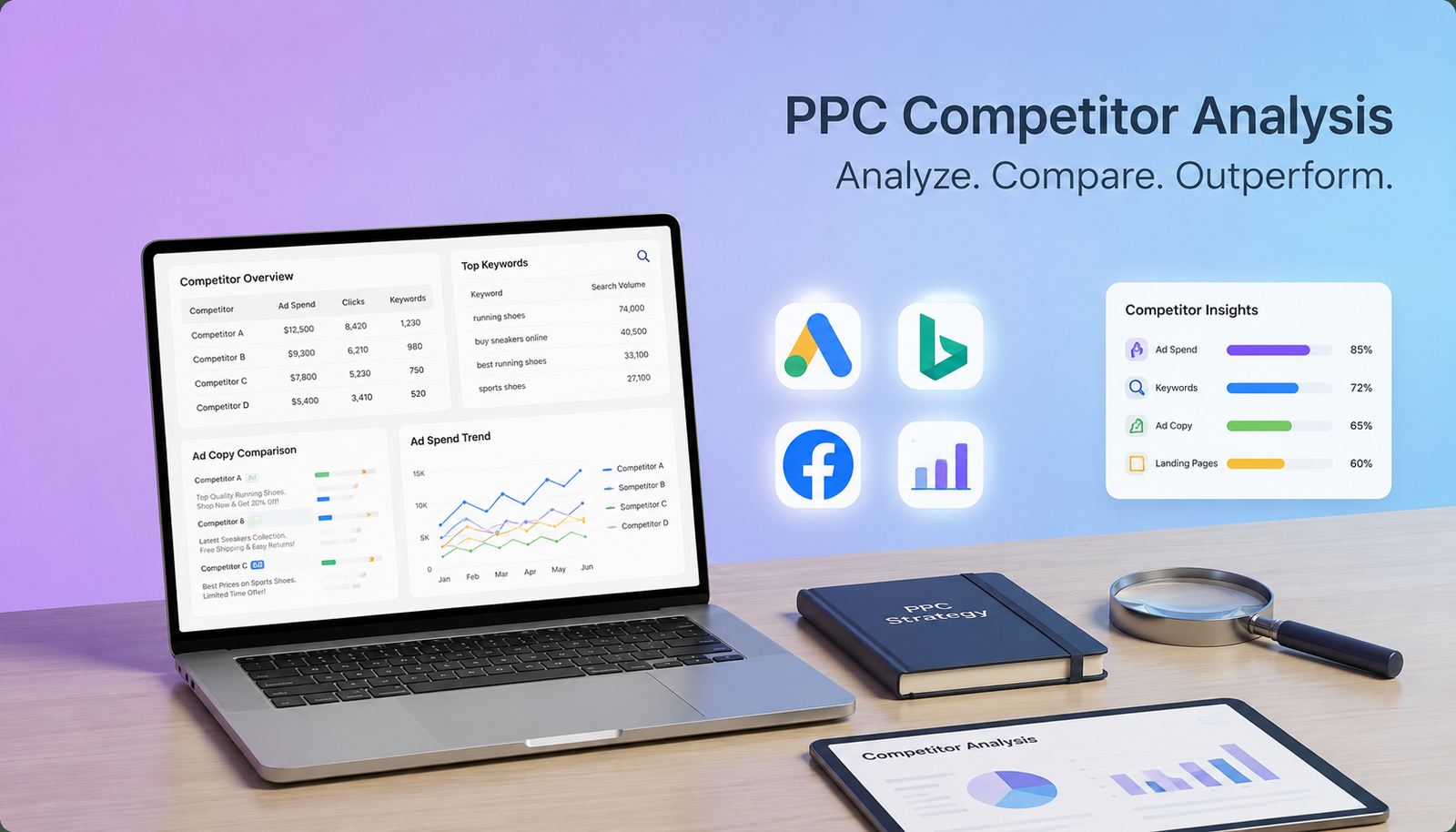
A friend who runs a small SaaS company called me a while back, frustrated. His cost per click had jumped 40% in three months, and nobody on his team could explain why. Nothing had changed on his end, same budget, same keywords, same landing pages. Turns out two new competitors had entered his space and started bidding hard on the exact terms he’d owned for two years. He didn’t find out from his ad platform. He found out by accident, three months late, after burning through thousands of dollars he didn’t need to lose.
That’s the whole case for this guide in one story. PPC competitor analysis isn’t some advanced agency trick reserved for six-figure ad budgets. It’s the difference between reacting to a problem after it’s cost you money and seeing it coming. Here’s exactly how to do it.
What Is PPC Competitor Analysis?
PPC competitor analysis is the process of studying how your competitors run their paid search campaigns, which keywords they bid on, what their ads say, how hard they’re competing for ad positions, and what their landing pages look like so you can make smarter decisions about your own campaigns.
Think of it like scouting the other team before a match. You’re not copying their playbook move for move. You’re figuring out where they’re strong, where they’re weak, and where there’s open field nobody’s covering yet.
One thing most guides skip: you’ll never see a competitor’s exact ad spend or exact conversion rate. Every tool claiming to show “competitor spend” is giving you a modeled estimate based on visible signals like ad position and typical CPC for that keyword. Still useful, just don’t treat it as gospel.
It’s also worth separating this from SEO competitor analysis, which looks at organic rankings and content instead of paid ads. They inform each other, but they’re not the same exercise.
Why Competitive PPC Analysis Is Important
Here’s the honest answer: Your competitors are already doing this to you, whether you’re doing it back or not. Your competitors are already doing this to you, whether you’re doing it back or not. This is particularly important when you’re competing against different types of advertising agencies and businesses with very different campaign strategies.
Every dollar you spend on Google Ads competes directly against every other advertiser bidding on that keyword. If you’re not watching, you’re playing an auction where everyone else can see more of the board than you can.
A regional HVAC company I know checks Auction Insights monthly, a five-minute habit, not a project. They once noticed a national franchise had started showing up on their branded search terms, essentially trying to steal clicks from people already searching for them by name. Because they caught it early, they tightened their brand campaign bids before it became expensive. That’s the value of this exercise: information early is cheap, information late is expensive.
There’s a second reason nobody talks about enough: PPC competitor analysis often reveals when you’re paying for keywords you already rank #1 for organically. If the free click is already yours, the paid one next to it can be wasted spend.
Benefits of PPC Competitor Analysis
Lower cost per click — understanding how competitors bid helps you know when to compete and when to walk away from a saturated term.
Better ad copy, faster — if three of your top competitors are all leading with “same-day service,” that’s a signal about what your shared audience responds to. Match it, or find the gap they’re all missing.
Landing pages that convert — if every competitor’s page is slow and cluttered, a clean, fast page becomes your edge without hiring a UX consultant.
Realistic benchmarks — instead of guessing whether a 2.1% CTR is good, you can compare it to what’s typical in your competitive set.
An early warning system — new competitor enters your market? You’ll know in weeks, not after your CPC mysteriously doubles.
This kind of Google Ads competitor analysis also feeds beyond the ad account. The keyword gaps and messaging angles you uncover can help shape your broader advertising strategies, blog topics, and pricing page copy too.
How to Perform a PPC Competitor Analysis (Step-by-Step)
- Find your real PPC competitors. These aren’t always your business rivals. A local bakery’s biggest business rival might be the shop two blocks away, but their biggest PPC competitor could be a national delivery app bidding on “birthday cake near me.” Search your core keywords in an incognito window and see who actually shows up.
- Check Google Ads Auction Insights. It’s free, already in your account, and barely used. Open any campaign and check the Auction Insights tab for impression share (what percentage of impressions you’re winning), overlap rate (how often a competitor shows alongside you), and position above rate (how often they outrank you). Check this monthly, minimum.
- Analyze their keywords. This is where competitor keyword research earns its cost, though there’s a free path too (see the tools section). You’re looking for gaps, terms competitors are winning traffic on that you’re not bidding on at all.
- Study their ad copy. Look at actual headlines and CTAs. Are they leading with price, speed, guarantees? Patterns across competitors tell you what your audience responds to, and the gaps tell you what nobody’s saying yet, which is often your opening.
- Evaluate their landing pages. Click through. Is the offer clear in five seconds? Does the page match what the ad promised? You’ll be surprised how often well-funded competitors have a weak page here, that’s a real advantage for you.
- Estimate spend carefully. Tools will give you a spend range. Treat it as a directional signal of scale, not a fact to plan your budget around.
- Document it and revisit regularly. A one-time analysis is stale within a month. Build it into a recurring habit, monthly for most industries, weekly for fast-moving ones like local services.
Best PPC Competitor Analysis Tools
| Tool | Best For | Starting Price | Free Tier? |
| Google Ads Auction Insights | Everyone, as a baseline | Free | Yes |
| SpyFu | Solo founders, small budgets | ~$39/month | Limited free searches |
| SEMrush | Growing SaaS/startups | ~$139/month | 10 searches/day |
| Ahrefs | Teams wanting SEO + PPC together | ~$129/month | Limited |
| iSpionage | Agencies tracking multiple accounts | ~$59/month | 5-day trial |
| Adthena | Enterprise, high-volume accounts | Custom | No |
If you’re a local business or solo founder with no tool budget, Auction Insights plus weekly incognito searches of your top 10–15 keywords gets you most of the value for free. If you’re scaling, SEMrush or Ahrefs are worth it since you’ll use them for SEO too. Just remember: no tool shows real competitor numbers — they’re all estimates, so cross-check any tool’s estimate of your own account against your actual data before trusting its estimate of anyone else’s.
A Quick Example
A project-management SaaS company was bidding on “team collaboration software” at $4.20 CPC, spending about $3,000/month. During a routine check, their impression share dropped from 68% to 41% in six weeks, a new competitor had entered aggressively with a “free forever” plan.
Instead of outbidding them head-on, the team checked their organic rankings and found they already ranked #2 organically for that term. They shifted budget to three related long-tail terms the competitor hadn’t touched and rewrote their ad copy around a differentiator (dedicated onboarding) the competitor’s page didn’t mention. CPC on the reallocated terms came in 22% lower over the next two months, with lead volume holding steady. The lesson: competitor analysis gave them a deliberate choice instead of a panicked reaction.
Common Mistakes to Avoid
- Treating estimated spend data as exact fact
- Doing this once and never revisiting it
- Copying competitor ad copy or bidding on their trademarked terms, which carries real legal risk depending on region and platform policy
- Only checking ads and ignoring landing pages
- Analyzing your business rivals instead of your actual PPC rivals
The Future of PPC Competitor Analysis
A few shifts are already underway. Real-time alerts are replacing monthly manual checks, tools increasingly notify you the moment a competitor’s bidding or copy shifts. Automated bidding types like Performance Max are making keyword-level tracking harder, pushing more attention toward creative and landing page analysis instead. AI-generated ad copy means competitors can rotate messaging faster than before, so checking more often matters more than it used to. And SEO and PPC competitive data are converging into single dashboards, making it easier to catch the budget overlap we covered earlier.
None of this changes the fundamentals, it just means the businesses paying attention now will adapt faster than the ones starting from zero later.
Conclusion
PPC competitor analysis isn’t a one-time audit, it’s a habit that pays for itself the first time it saves you from a CPC spike you didn’t see coming. Start small: check Auction Insights this week, pick two or three real competitors, and spend fifteen minutes looking at what they’re doing. You don’t need a big budget to start. You just need to start.