Different Types of Marketing Strategies: A Complete Guide to Growing Your Business
Customers no longer behave the way that they used to. Whereas previously, they may have seen an ad, then gone to the store and bought the advertised product, today the process is much more consultative. Customers now often spend time Googling their query, looking at social media posts, watching YouTube videos, reading reviews, and even asking ChatGPT before making a purchase decision. As such, relying on just one marketing channel is no longer sufficient. A multi-channel marketing approach is required if you want to maximize your reach.
In this guide, you’ll learn:
The different types of marketing strategies, where each is most appropriate, and how to combine them
What Is a Marketing Strategy?
A marketing strategy is a plan that allows a company to reach the right customer with the right marketing channels most effectively. Instead of randomly posting on social media or throwing money at Google Ads without a strategy, marketing lets you design your approach so that everything you do has a clear purpose.
An effective marketing strategy will have answers to the following questions:
- Who exactly are your customers?
- What problem are you solving?
- Which marketing channels should you use?
- What message should you communicate?
- How will you measure success?
For example, a local restaurant may focus on local SEO and Instagram marketing, while a SaaS company may invest in SEO, content marketing, LinkedIn advertising, and email automation.
Expert Insight: Many businesses believe marketing is about getting more traffic. In reality, successful marketing is about attracting the right visitors and guiding them toward becoming loyal customers.
For more insights, explore Core Marketing Concepts
Why Every Business Needs a Marketing Strategy
If you fail to implement a marketing strategy, your marketing efforts will be disjointed, ineffective, and a waste of resources. With the right marketing strategy in place, you’ll be able to:
- Reach your customers
- Grow your brand awareness
- Drive qualified leads to your business
- Boost conversions
- Retain customers
- Measure your marketing ROI
- Maximize your resources
You probably ask yourself, “What marketing channels should I use?” Instead, consider asking, “What marketing channels should my customers use?” This subtle shift in mindset often facilitates better marketing strategy decisions.
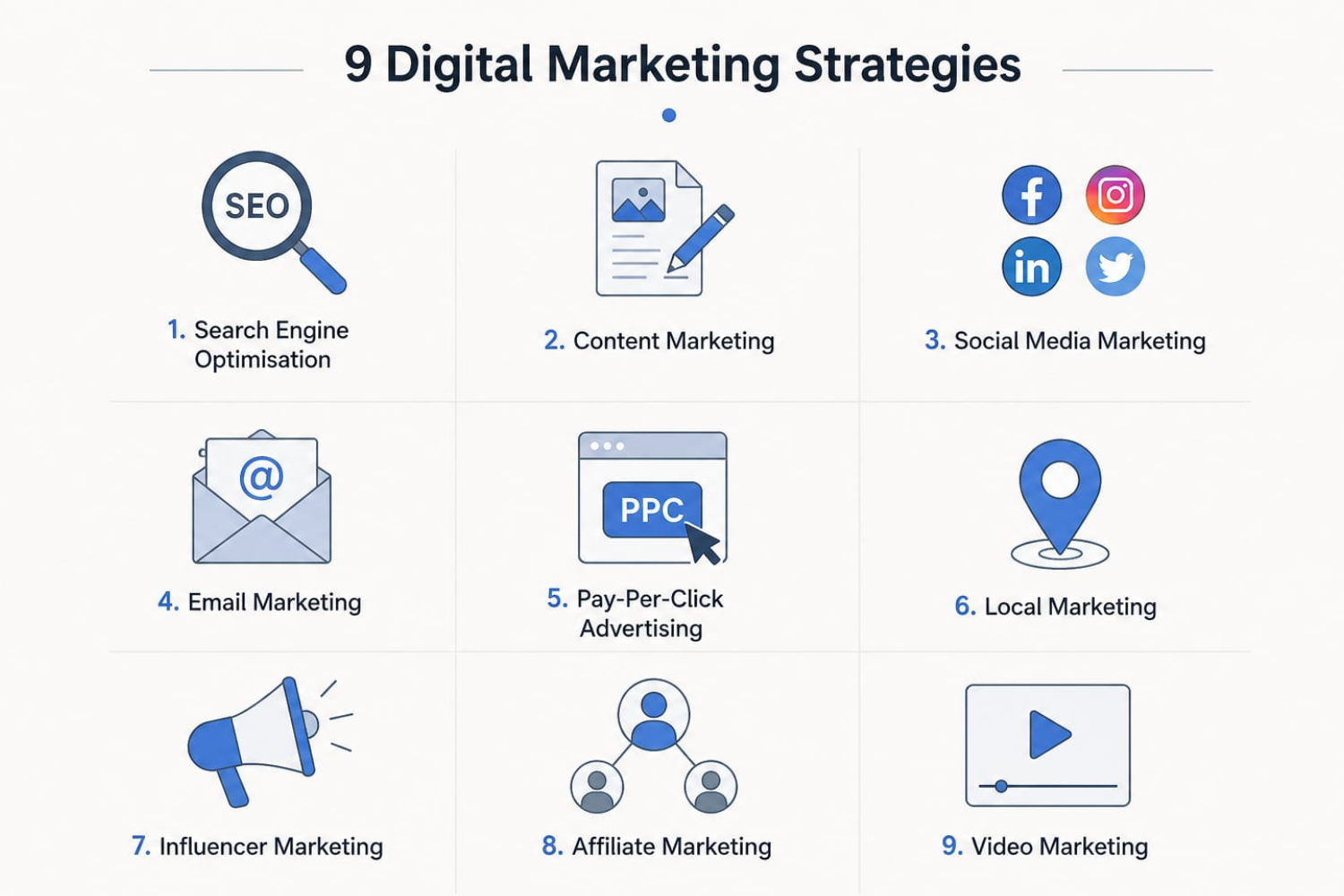 1. Search Engine Optimization (SEO)
SEO is one of the most important long-term marketing strategies that every business should employ. SEO aims to get your website discovered by search engines when somebody is searching for a relevant query.
Unlike PPC, SEO builds your website authority, which means that it will continue to drive visitors to your website long after you’ve initially launched the campaign. SEO involves publishing high-quality content, optimizing your website, conducting keyword research, technical optimization, building backlinks, and so on.
Best For
- Service businesses
- SaaS companies
- E-commerce stores
- Local businesses
- B2B companies
- Startups
When to use it
SEO should be used when your customers perform online research before buying your product/service
If customers are Googling specific questions about your industry, it indicates they are ready to begin their buyer journey. In such cases, SEO should be one of the primary marketing activities.
Main Benefits of SEO
- SEO drives high-quality organic traffic to your website
- It enhances your brand image
- Yields long-term results and ROI
- Improves AI search visibility
- Reduces reliance on paid advertising
Limitations
- Requires patience and persistence
- Needs continuous optimization
- Keywords often take time to rank
Real Business Example
Imagine a digital marketing agency publishing detailed guides about SEO, Google Ads, and website development. Instead of promoting only its services, the agency answers real customer questions. Over time, these educational articles attract qualified visitors who later become paying clients.
Pro Tip
Create content about your customers’ questions, not only about your business. Educational content is much more valuable for SEO and will organically attract inquisitive website visitors.
AI Search Tip
AI search engines prioritize content that demonstrates expertise and originality. Include practical examples, unique insights, and firsthand experience rather than repeating generic definitions.
For AI visibility, explore this article: How to Rank on AI Search in 2026
2. Content Marketing
Content marketing is about creating educational content that effectively guides and assists your customers. Through content marketing, you provide value to your customers before asking them to buy something from you. As such, many content marketing strategies are extremely heavy on educational content and light on direct sales pitches.
Best For
- Establishing authority
- Generating leads
- SEO
- Educating customers
- Long sales cycle
When It Works Best
Content marketing works best when your customers need guidance or research before buying from you. It is ideal for all industries where customers tend to conduct research before investing in your product/service. This is especially true for financial services, healthcare, tech, real estate, and digital marketing agencies.
Main Benefits of Content Marketing
- SEO-friendliness
- Enhances your brand image
- Contributes to various stages of the marketing funnel
- Provides evergreen traffic
- Builds customer trust
Limitations
- Takes time to yield results
- Requires high-quality content
- Needs to be frequently updated
Real Business Example
A cybersecurity company writes articles about ransomware and how businesses can protect themselves from various cybersecurity threats. This approach allows the cybersecurity company to position itself as an expert in the field. As such, when prospective customers are looking for a trustworthy organization to rely on, they choose this particular company.
KPIs to Track
- Organic traffic
- Time on page
- Scroll depth
- Backlinks
- Leads generated
- Returning visitors
AI Search Tip
Original statistics, research, expert opinions, and case studies have a much better chance of being cited by AI search engines.
3. Social Media Marketing
Social media marketing helps businesses connect with customers through platforms where they already spend their time. However, successful social media isn’t about posting every day. It’s about creating conversations, sharing useful content, and building relationships.
Best For
- Brand awareness
- Community building
- Product announcements
- Customer support
- Distributing content
When It Works Best
Social media performs exceptionally well for businesses with visually appealing products, active communities, or educational content that encourages sharing.
LinkedIn is ideal for B2B brands, while Instagram and Facebook are often more effective for B2C businesses.
Main Benefits of Social Media Marketing
- Boosts your brand awareness
- Facilitates engagement and community building
- Drives traffic to your website
- Supports paid media efforts
- Increases your reach and visibility
Limitations
- Limited organic reach
- Takes time to build an audience
- Requires frequent publishing
Real Business Example
A fitness coach shares workout tips, client transformations, and nutrition advice on Instagram.
Over time, followers begin trusting the coach’s expertise, making them more likely to purchase training programs or coaching services.
Pro Tip
Follow the 80/20 rule – 80% of your social media content should be educational or entertaining, and 20% should focus on directly promoting your business.
KPIs to Track
- Engagement rate
- Reach
- Website clicks
- Followers
- Leads
AI Search Tip
Social discussions increasingly influence brand authority. Consistent engagement and valuable educational content strengthen your overall digital presence.
4. Email Marketing
While traditional social media and Google searches are incredibly important, one marketing channel has one of the highest conversion rates of any marketing tactic: email marketing. Unlike social media, where you’re trying to attract random consumers, your email subscribers are already interested in your business and want to hear from you. As such, email marketing should always be a core part of your marketing strategy.
Best For
- Nurturing leads
- Customer retention
- Product launches
- Upselling and cross-selling
- Building long-term customer relationships
When It Works Best
Email marketing works best after someone has already shown interest in your business by subscribing to your newsletter, downloading a guide, or making a purchase.
Key Benefits
- Higher ROI than most other marketing channels
- Personalized communication
- Automated marketing workflows
- Encourages customer loyalty
- Facilitates resubscription
Limitations
- Requires a list of engaged subscribers
- Can be challenging if you have a small audience
- Some email platforms have spurious spam filters
Real Business Example
An HR software company has a free employee onboarding checklist that requires email subscription. Interested website visitors sign up and, over the following weeks, receive helpful HR-related emails before eventually being guided towards buying the company’s software.
KPIs to Track
- Open Rate
- Click-Through Rate
- Conversion Rate
- Unsubscribe Rate
- Revenue per Campaign
Explore: Tools of Email Marketing
5. Pay-Per-Click (PPC) Advertising
PPC advertising helps businesses appear at the top of search results almost instantly. Unlike SEO, where visibility is earned over time, PPC provides immediate exposure for relevant keywords. Check in detail Google Ads vs SEO
However, success depends on more than bidding higher than competitors. The landing page, ad copy, and offer all influence campaign performance.
Best For
- Generating leads
- Product launches
- Local businesses
- High-intent searches
- Seasonal promotions
When It Works Best
PPC performs exceptionally well when customers already know what they need and are actively searching for solutions.
Key Benefits
- Immediate traffic generation
- Precise audience targeting
- Measurable results
- Flexible budget
- Quick optimization
Limitations
- Traffic generation ceases when you stop paying
- Can be costly if you have a competitive niche
- Requires continuous optimization
Real Business Example
A law firm runs Google Ads targeting “divorce lawyer near me.” Instead of sending visitors to the homepage, each ad leads to a dedicated consultation page, increasing inquiry rates.
6. Local Marketing
If your customers are located within a specific city or region, local marketing should become a priority. Instead of competing nationally, local businesses focus on attracting nearby customers who are ready to buy.
Best For
- Restaurants
- Clinics
- Real estate agencies
- Gyms
- Salons
- Service providers
When It Works Best
Local marketing delivers excellent results when customers search using location-based keywords such as “near me” or “in Delhi.”
Main Benefits of Local Marketing
- Effective for acquiring local customers
- Better local visibility
- Improves store foot traffic
- Enhances your overall presence in the local community
Limitations
- Limited geographic reach
- Requires consistent local optimization
Real Business Example
A local dentist enhances her Google Business listing and encourages customers to post positive reviews on social media and Google. Moreover, she creates landing pages for specific areas so that she can appear in local searches.
Pro Tip
Customer reviews are essential for local businesses. Try to incentivize customers to leave positive reviews after every service.
KPIs to Track
- Local search optimization
- Phone calls
- Directions
- Google Business views
- Local inquiries
More information: Local SEO for Small Business
7. Influencer Marketing
Influencer marketing involves partnering with creators who already have the attention and trust of your target audience. Success depends on audience relevance rather than follower count.
Best For
- Fashion
- Beauty
- Fitness
- Travel
- Technology
- Lifestyle brands
Main Benefits of Influencer Marketing
- Enhances brand image
- Facilitates precise targeting
- Provides authentic content
Limitation
Finding the right influencer requires research and careful evaluation.
Expert Tip
A creator with 20,000 highly engaged followers often delivers better results than someone with one million inactive followers.
8. Affiliate Marketing
Affiliate marketing allows partners to promote your products in exchange for a commission on successful sales. This strategy helps businesses grow while paying only for actual results.
Best For
- E-commerce
- SaaS companies
- Online courses
- Digital products
Main Benefits of Affiliate Marketing
- Performance-based promotion
- Lower risk
- Expands your reach
Example
A software company rewards bloggers with a commission every time someone purchases its product through their referral link.
9. Video Marketing
Video has become one of the fastest-growing marketing channels because it explains ideas more effectively than text alone. Short videos, product demonstrations, customer testimonials, and educational tutorials all help increase engagement.
Best For
- Product reviews
- Educational content
- Company introduction
- Social media
Pro Tip
Your first five seconds determine whether viewers continue watching. Start with a question, problem, or surprising fact.
Common Marketing Mistakes to Avoid
Even experienced businesses make mistakes that reduce marketing performance.
Avoid these common issues:
- Using too many marketing channels at the same time
- Focusing only on traffic, as opposed to sales
- Disregarding the buyer’s intent
- Creating low-quality content
- Failing to track marketing performance
- Sending all website visitors to the homepage
- Giving up on SEO
The Future of Marketing Strategies
Marketing continues to evolve as customer behaviour changes.
Businesses that succeed over the next few years will focus on:
- AI-assisted content creation with human expertise
- Personalized customer experiences
- First-party data collection
- Voice and conversational search
- Video-first communication
- Omnichannel marketing
- AI search optimization
Companies that create original, experience-driven content will have a competitive advantage as AI-powered search engines continue prioritizing trustworthy information.
Final Thoughts
Understanding the different types of marketing strategies helps businesses make smarter decisions instead of following trends blindly.
SEO builds long-term visibility. Content marketing earns trust. Social media creates conversations. Email strengthens customer relationships. PPC generates immediate traffic, while local marketing helps nearby customers discover your business.
Rather than depending on a single channel, create a marketing system where every strategy supports the next stage of the customer journey.
When businesses combine valuable content, data-driven decisions, and consistent optimization, marketing becomes more than just promotion—it becomes a predictable engine for sustainable business growth.
If you want to build a successful marketing strategy but don’t know where to start, India Digital Agency is here to help. We’ll assist you in developing a powerful marketing mix that drives traffic, engages leads, converts prospects, and accelerates your business growth.