Shopify Ecommerce Website Development in 2026: Full Guide by IDA
Here’s something worth thinking about: if two online stores are selling the exact same product at the same price, why does one end up making five times more revenue?
In most cases, it’s not luck, it comes down to the platform they’re using and how well the store is built. More often than not, the store that outperforms the other is powered by Shopify and backed by a clear strategy and smart execution.
Over the years, Shopify’s ecommerce website development has become the go-to choice for brands that are serious about growing online. Whether you’re just starting your first business or you already run an established store and want to scale, Shopify gives you the speed, flexibility, and tools needed to build a store that actually converts.
In this guide, we’ll break everything down in a simple way—from what Shopify development really involves to pricing, comparisons with other platforms, and how to choose the right development partner in India.
Already thinking about launching your store? Explore our Shopify website development services to see how we help brands go live faster
What Is Shopify Development?
Before we go into how it works, first understand what it is.
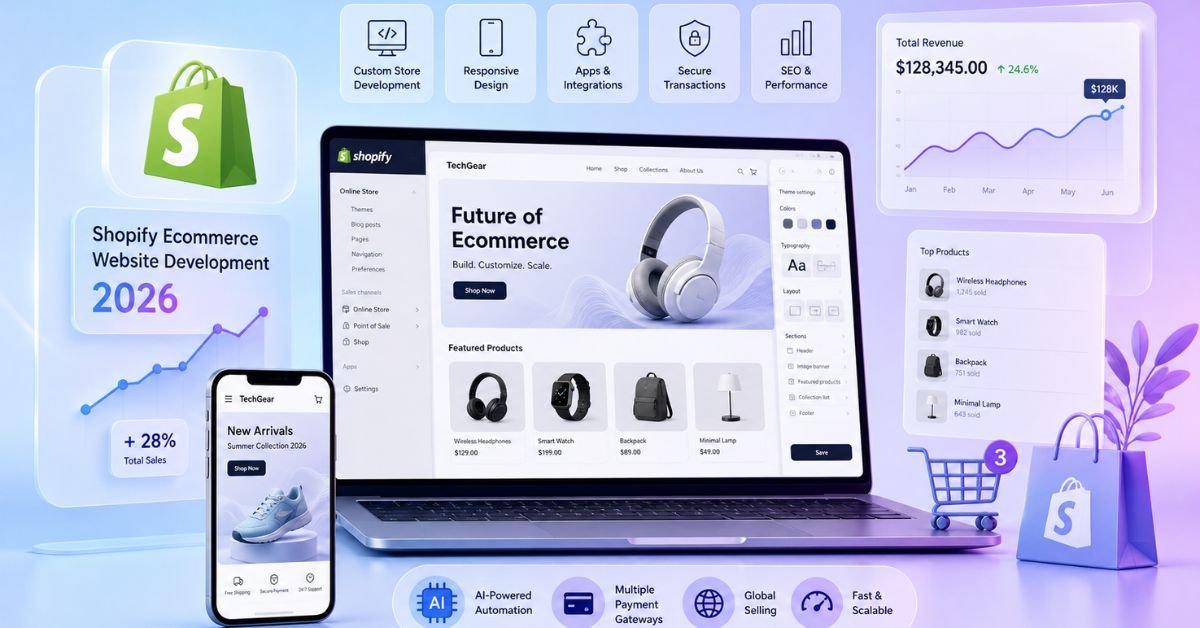
Shopify development means building, customizing, and improving an online store using the Shopify platform. It is one of the most popular tools for creating ecommerce websites. Shopify gives you a secure and reliable setup to sell products online. But Shopify development is not just about selecting a theme. It also includes:
- Custom theme design and front-end development using Shopify’s Liquid templating language
- App integrations (payment gateways, inventory tools, CRM systems)
- Store configuration — collections, product pages, checkout flows
- Performance optimisation for speed and mobile responsiveness
- SEO setup and analytics integration
Why choose Shopify?
There’s a reason over 4.8 million stores globally run on Shopify. The platform’s managed infrastructure means you never worry about server downtime during a flash sale. Its App Store offers 8,000+ integrations. And its checkout conversion rates consistently outperform industry benchmarks.
From a marketing growth strategy perspective, Shopify gives you the tools to run email campaigns, retargeting ads, abandoned cart recovery, and loyalty programs. All from one dashboard. That kind of unified data view is invaluable when you’re trying to scale.
The platform also has built-in SEO features, mobile-first themes, and fast page load speeds, three non-negotiables in the post-Core Web Vitals era of Google ranking.
Advantages of Shopify for Ecommerce Stores
- Hosted solution: No server management needed
- PCI-DSS compliance out of the box (critical for payment security)
- Native multi-currency and multilingual support
- Shopify Markets for cross-border selling
- Headless commerce capability for advanced storefronts
You can also dive deeper into the advantages and disadvantages of ecommerce in 2025 to understand the broader landscape before committing to a platform.
Shopify vs WooCommerce vs Magento: Which One Should You Choose?
This is probably the most searched question among ecommerce entrepreneurs. Let’s cut through the noise with a practical comparison.
Shopify — Best For: Fast launch, managed hosting, scalable growth
Shopify is a fully hosted SaaS platform. You pay a monthly fee, and Shopify handles security patches, server uptime, and updates. Setup is faster, the learning curve is gentle, and you can focus entirely on selling.
WooCommerce — Best For: WordPress users, content-heavy stores
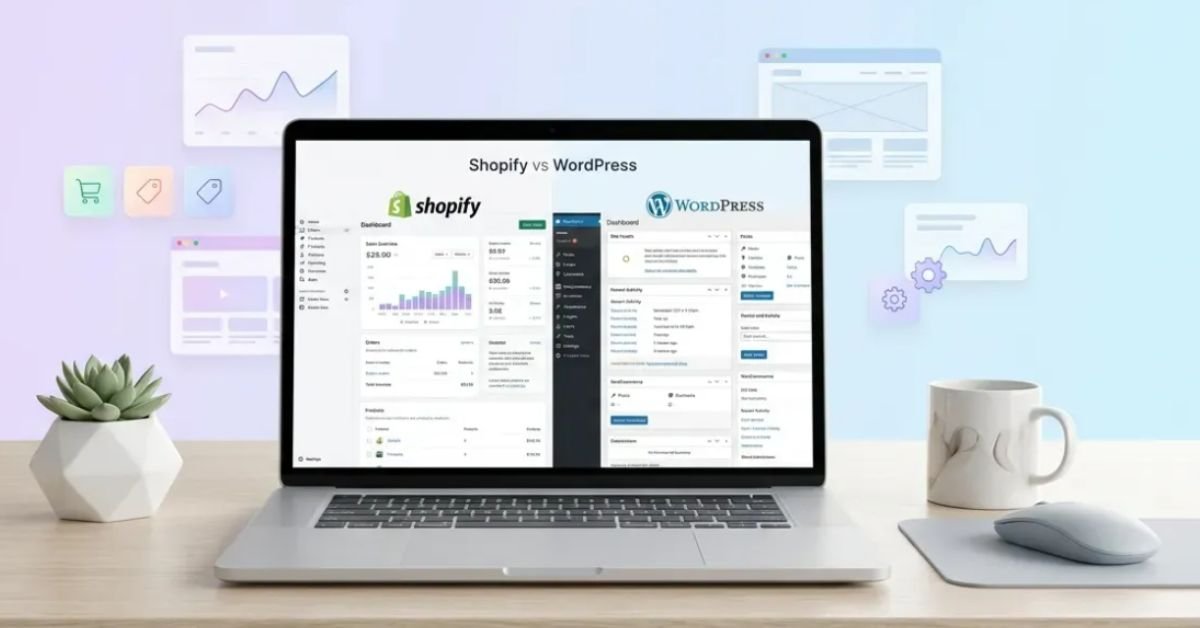
WooCommerce is a WordPress plugin—powerful, but you’re responsible for hosting, security, and maintenance. For stores that also publish a lot of editorial content, it can be a good fit. Check out our detailed WooCommerce vs Shopify comparison to understand the full technical and cost differences.
Magento (Adobe Commerce) — Ideal: Enterprise-level, complicated catalogs.
The ecommerce world has been given a heavy load by Magento. It is highly customizable but requires significant developer resources and infrastructure investment. It is appropriate for brands whose inventory is very complex, which have multiple storefronts, or have very specific checkout logic.
Shopify is the magic middle ground of capability, cost, and speed to market, and most small- to mid-size businesses, as well as many enterprise brands.
How to Build an Ecommerce Website with Shopify: Step-by-Step Overview
Step 3: Configure Products, Payments & Shipping
Include your product catalog with appropriate metadata, titles, descriptions, tags, and alt texts that are all relevant to SEO. Install payment gateways (Shopify Payments, Razorpay, and PayU in India), set up shipping areas, and define tax settings.
Step 4: Install Apps and Integrations
Shopify App Store is among the best strengths of this company. Apps that you will typically install include email marketing, reviews, upsell/cross-sell, loyalty programs, and analytics. Be selective, each application will increase the page load time.
Step 5: SEO & Performance Setup
Set meta titles, descriptions, canonical URLs, sitemaps, and schema markup. Reduce the size of images, lazy load, and test your Core Web Vitals before launching. A technically correct store at the start saves colossal rework in the future.
Step 6: Test and Launch
Conduct end-to-end checkout tests with devices and browsers. Test discounting codes, gift cards, and edge-case inventory situations. Then, only throw the switch.
Ready to skip the trial-and-error? Our Shopify website development team handles everything from theme design to launch. So you can focus on growing your business.
Shopify Website Development Cost in India
One of the most common questions we hear is, “What will it actually cost?” The honest answer is it depends. But let’s give you real numbers.
Basic Shopify Store (DIY with a free theme)
Shopify subscription: ₹1,994–₹7,447/month | Theme: Free | Setup: Self-managed. Best for early-stage solo entrepreneurs testing a niche.
Professional Store (Agency or freelancer, premium theme)
Development cost: 25,000-80,000| Includes custom home page design, product page templates, application setup, and basic SEO setup. Applicable to an online adaptation of established small businesses.
Custom Shopify Development (Fully bespoke theme + integrations)
Cost of development: ₹80,000-300,000+ | includes custom Liquid theme, headless/API integration, ERP/CRM integration, and advanced UX. Where the brands require differentiation as a competitive advantage.
For a more detailed breakdown, our ecommerce website development cost guide for India covers all platforms and project types with transparent pricing benchmarks.
Shopify Ecommerce Website Examples That Convert
The most appropriate way to know what great Shopify development looks like is to study what works. These are the features of high-converting Shopify stores:
- Rapid loading product pages (LCP less than 2.5 seconds)
- Excellent value proposition above the fold on the home page.
- Social proof – reviews, user-created content, trust badge – at points of decision.
- Simplified checkout form with few form fields and various payment methods.
- Mobile-first design (6070% of all ecommerce traffic is mobile)
Industries like fashion, beauty, food & beverage, and electronics tend to see the strongest ROI on Shopify it’s largely because the platform’s visual merchandising tools are second to none.
Common Mistakes While Choosing Shopify Ecommerce Website Development Services
- Choosing based only on low price instead of overall quality
- Not checking the developer’s experience with Shopify
- Ignoring portfolio and past work
- Poor communication and unclear understanding of your requirements
- Focusing only on design and not on performance
- Not considering SEO and proper site structure
- No support or guidance after the store goes live
- Not planning for future growth and scalability
Why Choose India Digital Agency for Shopify Ecommerce Website Development
Don’t Overlook Ecommerce Security
One aspect of Shopify development that often gets discussed only after a problem occurs is security. Shopify’s hosted nature handles much of the heavy lifting—but your responsibility doesn’t end there. Customer data protection, third-party app permissions, and fraud prevention settings all need active management. Our guide on ecommerce security best practices is worth a read before you go live.
Conclusion
Shopify ecommerce website development isn’t just a technical exercise. It’s a strategic investment in your brand’s future. When done right, your store becomes a 24/7 sales engine that works while you sleep, scales as you grow, and adapts to changing market conditions without expensive re-platforming.
The key is to approach development with a clear plan: know your audience, design for conversion, optimize for search, and never treat launch as the finish line.
Whether you’re comparing Shopify vs WooCommerce vs Magento, calculating Shopify website development cost in India, or ready to build your first store, the most important move is the one you make next.
Ready to Build Your Shopify Store?
If you want to grow your business with a high-converting Shopify store built for performance and scale, get in touch with our team today. We offer end-to-end Shopify website development services — from strategy and design to launch and ongoing optimization.