Advertising Strategies: Definition, Types, Examples & How to Create One That Works
Advertising looks simple from the outside. You create an ad, choose a platform, set a budget, and wait for people to respond.
In reality, it rarely works that neatly.
Great ads can be very expensive, and they can still not produce sales. Sometimes, the issue is the audience. Sometimes the offer is not at a high enough level. At times, the ad attracts attention, but the customer goes elsewhere. In other words, in some instances the business is actually marketing in a region where its clients won’t locate.
This is why advertising strategies matter.
A strategy gives your advertising a purpose. Instead of spending money and hoping something works, you have a reason behind the audience you’re targeting, the platform you’re using, the message you’re showing, and the amount you’re willing to spend.
What Is an Advertising Strategy?
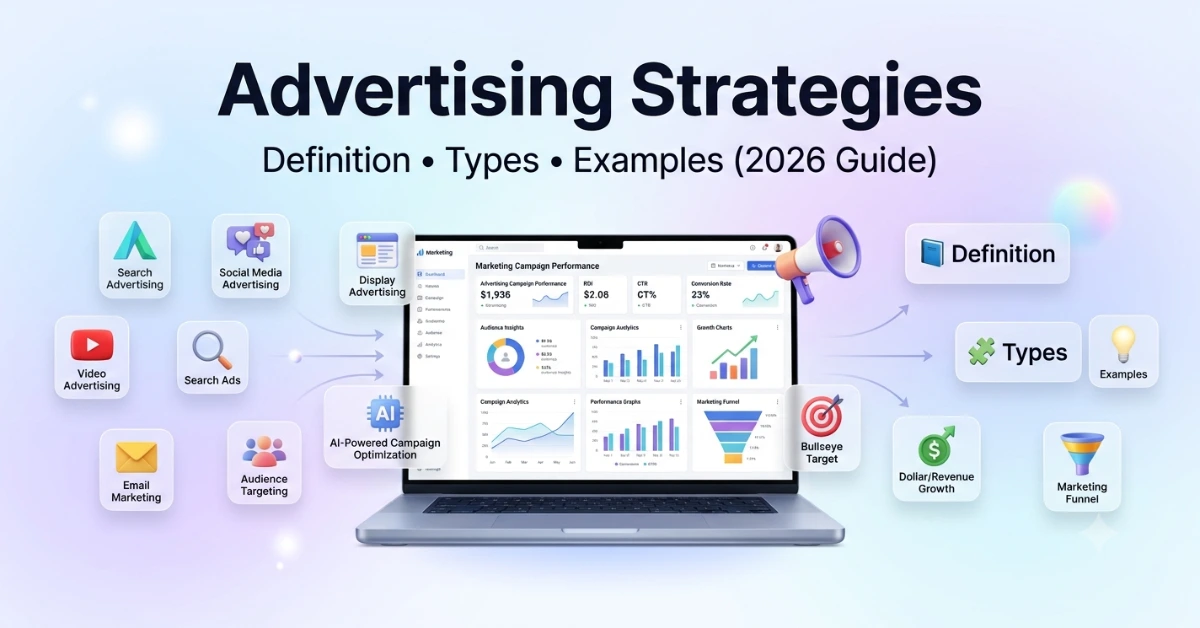
An advertising strategy is the approach a business takes to promote its products or services to potential customers.
It covers much more than the advertisement itself.
Before launching a campaign, you need to think about who you’re trying to reach, what you want from the campaign, what would make that person interested, and where they are most likely to see your message.
For example, imagine a company that provides WordPress development services.
It could simply run ads saying, “We build WordPress websites.”
Or it could think about the people it wants to attract. Perhaps they’re small business owners with outdated websites who are worried about losing customers. The company could then create an ad around website redesign, explain the problem it solves, and send visitors to a page specifically about that service.
Both are advertisements. The second one has a strategy behind it.
Why Advertising Strategy Matters
The biggest mistake businesses make with advertising is treating it as a traffic problem.
More traffic isn’t always what you need.
If you sell expensive business software, 10,000 random visitors won’t necessarily help. You might get much better results from 100 people who actually fit your target customer profile.
Successful advertising strategies help businesses reach the right audience, improve campaign performance, and make better use of their advertising budget.
You Know Who You’re Paying to Reach
Every advertising platform gives you targeting options, but having options doesn’t mean you should use all of them.
A local clinic may only need to reach people within a certain area. A B2B company might care more about job titles and industries. An e-commerce brand may focus on interests, shopping behavior, or previous website visitors.
The audience should come from the business, not from whatever targeting option happens to be available in the ad platform.
Your Budget Has a Purpose
Advertising budgets disappear quickly when campaigns aren’t monitored.
A strategy gives you a starting point for testing. You can see which ads generate useful traffic, which ones produce leads, and which campaigns actually contribute to sales.
Then you can make a decision about where to put more money.
You Can Learn From the Campaign
Not every campaign will work.
That’s normal.
The useful thing about digital advertising is that a campaign can tell you something. Maybe one headline gets more enquiries. Perhaps people respond better to a particular offer. Maybe a certain audience clicks frequently but never converts.
Those details are useful when planning the next campaign.
Types of Advertising Strategies
There are plenty of advertising options available today. The challenge isn’t finding a platform. It’s figuring out which one makes sense for your customers.
1. Search Advertising
Search advertising is one of the most effective advertising strategies because it reaches people who are actively searching for a product or service.
A person searching for “SEO agency in India” has a very different mindset from someone casually scrolling through Instagram. They already know what they’re looking for. This makes search advertising especially effective because you can reach potential customers when they’re actively looking for a solution.
Example: A home renovation company wants more enquiries. It can target searches related to home renovation in the cities it serves and send those visitors to a page showing its services, previous work, and contact options.
The important part isn’t simply getting the click. The landing page needs to continue the conversation started by the ad.
2. Social Media Advertising
Social media advertising does well when you are looking to generate interest in a product or service offering or a brand. People aren’t just going on Instagram or Facebook shopping.
To capture attention, your ad needs to give people a reason to stop scrolling. Visual content, short videos, customer stories, and strong offers often perform well because they quickly spark interest.
Example: A clothing brand launching a new collection could use Instagram to show the products in real situations rather than relying only on product photographs.
Someone who visits the website but doesn’t buy can then be included in a remarketing campaign.
3. Display Advertising
Display ads are placed on a variety of websites and apps and can be used for awareness or remarketing.
You’ve probably experienced remarketing yourself. You check out a product on one site and then see it on another.
This can be beneficial for businesses as not everyone purchases anything the first time that they visit a website.
For instance, a SaaS might use display advertising for a sure report or a guide as a way to promote a free resource. A person who downloads it will then be transferred to an e-mail campaign where the company offers additional details concerning its product.
4. Video Advertising
Some products are difficult to explain in a single image or headline.
Video gives you more room to demonstrate what something actually does.
A software company could show how its platform handles a task that employees currently perform manually. A fitness brand could demonstrate how its equipment is used. A restaurant could show how a popular dish is prepared.
The point isn’t to make a five-minute commercial.
Sometimes 20 or 30 seconds is enough to communicate something that would take several paragraphs to explain.
5. Influencer Advertising
Influencer advertising works best when the creator has a genuine connection with the audience you’re trying to reach.
And follower count shouldn’t be the only thing you look at.
A smaller creator with an audience interested in fitness, technology, beauty, finance, or another specific subject may be much more useful than a celebrity whose audience has little connection with your product.
For example, a fitness company might work with several niche fitness creators who can actually demonstrate the product rather than simply holding it up in a sponsored post.
6. Local Advertising
When your customers are in a certain geographic location, it’s a good idea to advertise in the area.
Consider doctors, restaurants, salons, repair shops, real estate agents and home services.
A dental clinic in Delhi does not have to devote its whole budget for the purpose of reaching people throughout India.
It can target localised search, localised social media campaigns, local landing pages and its Google Business Profile.
The aim is straightforward – if someone in the vicinity requires that service, the business needs to be easy to find.
7. Traditional Advertising
There are lots of useful advertising channels that are not digital.
Still, television, radio, newspapers, magazines, billboards and direct mail can prove effective, especially for companies with a local or regional base.
For a new retail outlet, they may well have billboard, local radio and digital campaigns all running at the same time, to build awareness and interest, and then direct traffic to a website.
It should be based on the audience and not whether it is a “modern” channel.
Advertising Strategy Examples
The best way to understand advertising strategies is to look at how different businesses might use them.
Local Service Company
A home cleaning company wants more bookings.
It could use search ads to reach people actively looking for cleaning services, local SEO to attract organic searches, remarketing to bring back website visitors, and customer reviews to build trust.
The company isn’t relying on one advertisement to do everything.
Each activity has a different job.
E-commerce Brand
An online fashion store has more opportunities to interact with customers.
Someone might discover a product on Instagram, visit the website, leave, see a remarketing ad later, and finally purchase after receiving an email about a discount.
The advertising strategy needs to account for that journey.
B2B Software Company
B2B sales can take weeks or months.
A potential customer may read several articles, compare different products, speak with colleagues, and attend a demo before making a decision.
For that reason, a B2B SaaS company might combine Google Ads, LinkedIn advertising, educational content, webinars, remarketing, and email.
The first interaction doesn’t have to produce a sale. It may simply need to get the right prospect interested.
How to Create an Advertising Strategy
Start With the Business Goal
Don’t begin by asking, “Should we advertise on Google or Instagram?”
Start with the business problem.
Do you need more enquiries? More online purchases? More demo requests? More people to know about your brand?
The answer will influence everything that follows.
Understand Your Customers
Spend time learning how your customers actually make decisions.
What do they search for?
What questions do they ask?
What stops them from buying?
What alternatives are they considering?
The answers can make your advertising much more relevant.
Choose the Platform
Search advertising is often the best choice when customers are actively looking for your service. For products that rely on visual discovery, social media can deliver better results. Rather than trying to be everywhere, focus on the platforms your audience uses most.
Build the Message
Effective ad copy doesn’t have to be witty.
It must be logical to the reader.
Let them know what you provide, why it is important for them, and what they need to do next.
Any hint that your landing page isn’t what you promised in the ad will be noticed.
Test Before You Scale
Don’t put your entire budget behind one idea.
Test different headlines, creatives, audiences, offers, and landing pages.
You may be surprised by what works.
A campaign you expected to perform well might struggle, while a simple variation may produce better leads at a lower cost.
Common Advertising Mistakes
A few mistakes appear across almost every industry.
Targeting everyone: A larger audience isn’t automatically a better audience.
Chasing clicks: Clicks are useful, but sales and qualified leads matter more.
Ignoring the landing page: A strong advertisement can’t compensate for a confusing website.
Using the same message everywhere: Someone searching Google is in a different mindset from someone scrolling Instagram.
Not tracking conversions: Without conversion tracking, you’re making decisions with incomplete information.
Scaling too quickly: A campaign that works at a small budget may need adjustments before you increase spending significantly.
Advertising Strategy vs. Marketing Strategy
Advertising is just one component of marketing.
Some other marketing areas include SEO, content marketing, social media marketing, email marketing, branding, public relations, and website optimization.
These activities may be complementary.
For instance, SEO may drive traffic to your site without the need to spend money on each visitor. You can connect with potential customers right away with advertising. Email can continue to converse with people who aren’t ready to purchase now.
The best strategy is to use multiple channels—usually two or more.
Conclusion
In an effective advertising strategy, selecting the most popular platform is not the key. It’s more than just about reaching the right audience with the right message at the right time. Regardless of the channels you choose, the most successful advertising strategies are based on continuous testing, performance tracking, and ongoing optimization.
When it comes to driving better-qualified leads, higher sales, or greater ROI on advertising dollars, the right experts can help you make the difference. India Digital Agency can assist your business in developing and running successful advertising campaigns that are focused on your objectives.
Check out our Google Ads, Meta Ads, and other digital marketing solutions to discover how we can benefit your business. When in doubt, make a free appointment with our team, and we’ll let you know the best advertising solution for your company.