Skip to content
13 Types of Email Marketing You Should Know for Better Results
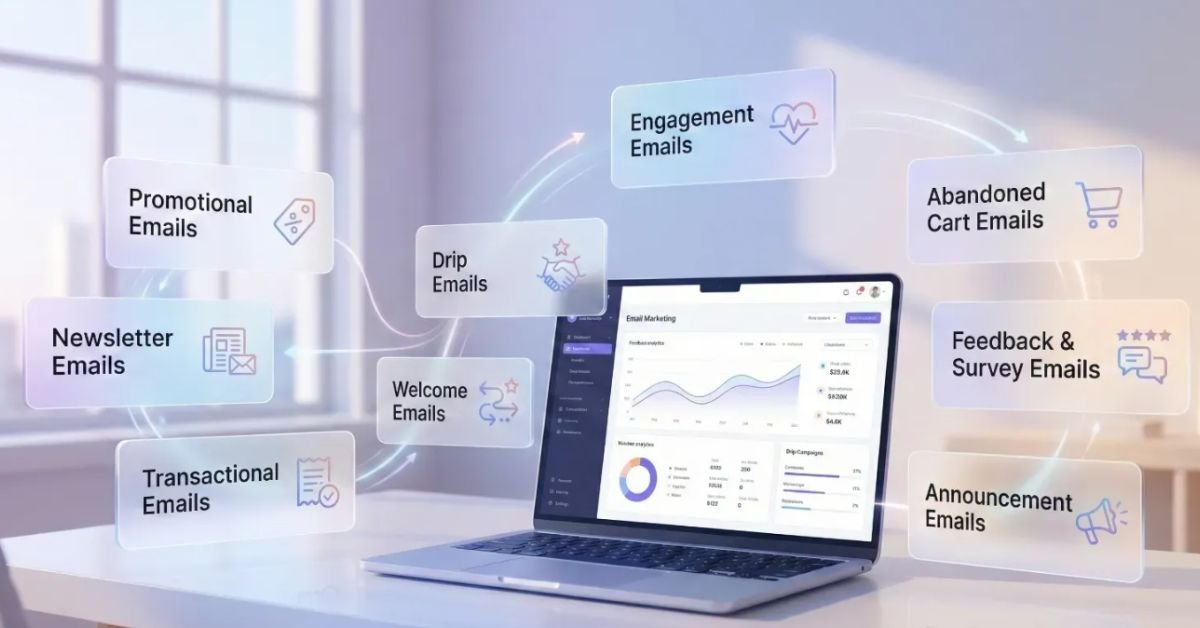
Email marketing continues to deliver one of the highest returns on investment among all digital marketing channels. However, the real problem is not email marketing itself, it’s using the wrong type of email for the wrong audience.
For example, sending discount emails to new subscribers or sending newsletters to ready-to-buy customers leads to low engagement and poor conversions. That’s why understanding the different types of email marketing is critical.
In this guide, you’ll learn each type of email marketing, what it is used for, and how businesses apply it in real scenarios.
What Are the Types of Email Marketing?
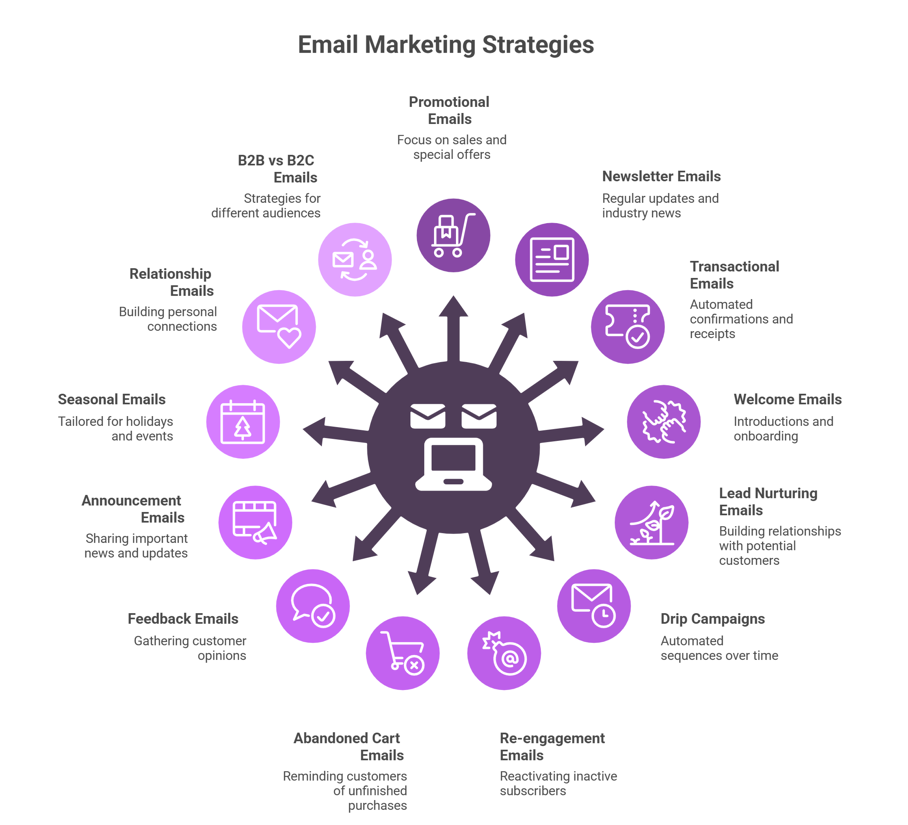
Types of email marketing refer to different formats and purposes of emails that businesses send depending on:
- The goal of the campaign
- The behavior of the subscriber
- The stage of the customer journey
Instead of sending the same email to everyone, businesses use specific email types to educate, sell, follow up, or re-engage users.
Using the correct email type helps:
- Increase open rates
- Improve click-through rates
- Build long-term customer trust
1. Promotional Email Marketing
Promotional email marketing is used to encourage immediate action by promoting products, services, offers, or deals. The primary objective is sales or conversions.
Common Use Cases
- Discount offers – Encouraging users to buy by offering price reductions
- Product launches – Informing subscribers about new products or features
- Limited-time deals – Creating urgency to drive faster decisions
Examples of Promotional Emails
- “Get 20% Off on Your First Order” – pushes first-time buyers
- “New Feature Launched – Try It Today” – promotes updates
- “Last Day to Claim the Offer” – triggers urgency
Promotional emails perform best when sent to segmented audiences who have already shown interest. Overusing them can reduce engagement and increase unsubscribe rates.
2. Newsletter Email Marketing
Newsletter email marketing focuses on regular communication rather than direct selling. These emails help businesses stay connected with their audience over time.
Purpose of Newsletters
- Sharing valuable information that helps or educates subscribers
- Keeping the brand top-of-mind without aggressive selling
- Driving traffic to blogs, videos, or resources
Types of Newsletter Content
- Educational tips related to your industry
- Blog post updates with short summaries
- Company news or announcements
- Expert insights or case studies
Newsletters are ideal for relationship building and are widely used by agencies, bloggers, SaaS companies, and educators.
3. Transactional Email Marketing
Transactional emails are automated emails sent after a specific user action. These emails are mandatory and expected by users.
Common Transactional Email Examples
- Order confirmation – confirms a successful purchase
- Payment receipt – provides billing details
- Password reset – helps users regain account access
- Account verification – confirms email authenticity
Why Transactional Emails Are Important
Transactional emails have very high open rates because users actively look for them. Clear content, proper formatting, and brand consistency improve user trust and overall experience.
4. Welcome Email Marketing
Welcome emails are sent immediately after a user subscribes, registers, or joins your email list. This is the first official interaction between your brand and the subscriber.
When Welcome Emails Are Triggered
- Signing up for a newsletter
- Creating an account on a website
- Downloading a free guide or resource
Role in Customer Onboarding
A strong welcome email should:
- Introduce your brand clearly – Explain who you are and what your business does in one simple sentence
- Set expectations – Tell subscribers what kind of emails they will receive and how often
- Guide the next step – Encourage users to explore your website, read a blog, or check a product
Welcome emails help establish trust early and significantly improve long-term engagement.
5. Lead Nurturing Email Marketing
Lead nurturing email marketing focuses on building trust and educating potential customers before trying to sell anything. These emails are sent to users who are interested but not ready to buy yet.
Instead of pushing offers, nurturing emails slowly moves leads toward a buying decision.
How Lead Nurturing Emails Work
- They provide useful information related to the user’s problem
- They answer common questions and objections
- They position your brand as a trusted expert
Stages of Lead Nurturing Emails
- Awareness stage – Educating users about a problem or topic
- Consideration stage – Explaining solutions and comparisons
- Decision stage – Introducing services, case studies, or offers
Lead nurturing is critical in B2B, high-ticket services, and SaaS businesses, where customers don’t convert instantly.
6. Drip Email Campaigns
A drip email campaign is a series of pre-written, automated emails sent over a specific period. These emails are triggered by user actions or time intervals.
Each email in a drip campaign has a specific purpose and builds on the previous one.
How Drip Emails Are Scheduled
- Based on time gaps (Day 1, Day 3, Day 7, etc.)
- Based on user behavior (clicks, downloads, sign-ups)
Common Drip Campaign Examples
- New user onboarding series
- Educational email series
- Free trial follow-up emails
- Course or webinar email sequences
Drip campaigns save time, ensure consistency, and help guide users step-by-step through the funnel.
7. Re-engagement Email Marketing
Re-engagement email marketing targets inactive or unresponsive subscribers who haven’t opened or clicked emails for a long time.
The goal is not selling, it’s reviving interest or cleaning the list.
Why Businesses Need Re-engagement Emails
- Improves email deliverability
- Reduces inactive subscribers
- Rebuilds connection with old users
Examples of Re-engagement Emails
- “We Miss You – Here’s What’s New”
- “Still Want to Hear from Us?”
- “Exclusive Offer Just for You”
If users still don’t respond, removing them is better than hurting your email performance.
8. Abandoned Cart Email Marketing
Abandoned cart emails are sent to users who add products to their cart but don’t complete the purchase. This type of email focuses on recovery, not promotion.
When Abandoned Cart Emails Are Sent
- A few hours after cart abandonment
- Follow-up reminders within 24–72 hours
How They Help Increase Conversions
- Remind users about forgotten items
- Address common concerns like price or shipping
- Encourage completion with reassurance or incentives
Abandoned cart emails are extremely effective in e-commerce businesses and directly increase revenue.
9. Feedback & Survey Email Marketing
Feedback email marketing is used to collect customer opinions, reviews, and experiences after a purchase or interaction.
These emails help businesses understand what’s working and what’s not.
Types of Feedback Emails
- Product review requests
- Customer satisfaction surveys
- Service experience feedback
How Businesses Use Feedback
- Improve products or services
- Fix customer pain points
- Build credibility through reviews
Feedback emails show customers that their opinion actually matters, which improves loyalty.
10. Announcement Email Marketing
Announcement email marketing is used to inform subscribers about important updates related to a business. These emails are informational, not aggressive sales emails.
What Announcement Emails Usually Include
- New product or service launches
- Website updates or feature releases
- Company news or milestones
- Event or webinar announcements
Announcement vs Promotional Emails
Announcement emails focus on information, while promotional emails focus on selling. Mixing the two confuses users and lowers engagement.
11. Seasonal & Holiday Email Marketing
Seasonal email marketing targets specific times of the year when customer buying behavior changes, such as festivals, holidays, or annual sales periods.
Examples of Seasonal Campaigns
- Diwali, Christmas, New Year offers
- Black Friday or Cyber Monday sales
- End-of-season clearance emails
Why Timing Matters
Sending the right email at the right time increases relevance, urgency, and conversions. Poor timing makes even good offers fail.
12. Relationship-Building Email Marketing
Relationship-building emails focus on trust, value, and long-term engagement, not instant sales. These emails humanize your brand.
Types of Relationship-Building Emails
- Educational emails that solve problems
- Story-based emails sharing brand journeys
- Value-driven emails without CTAs
Why These Emails Matter
Brands that only sell lose subscribers. Brands that educate and connect retain them. Relationship emails improve lifetime value and loyalty.
13. B2B vs B2C Email Marketing Types
B2B Email Marketing
- Focuses on education, logic, and ROI
- Common email types: lead nurturing, newsletters, case studies
- Longer decision-making cycles
B2C Email Marketing
- Focuses on emotions, urgency, and offers
- Common email types: promotional, abandoned cart, seasonal emails
- Faster buying decisions
Using B2B-style emails in B2C (or vice versa) is a strategic mistake.
How to Choose the Right Type of Email Marketing
Most businesses fail at email marketing not because email doesn’t work, but because they choose the wrong type of email for their objective. Email marketing is not “one-size-fits-all.”
To choose the right type, you must align three things clearly:
- Business Goal
Ask one direct question: What do I want from this email?
Sales or conversions → Promotional, Abandoned Cart, Seasonal Emails
Education or trust building → Lead Nurturing, Newsletters
Retention or loyalty → Relationship-building, Feedback Emails
Activation or onboarding → Welcome Emails, Drip Campaigns
If your goal is unclear, your email will be unclear, and users won’t act.
- Audience Stage (Customer Journey)
Different users need different emails.
New subscribers need welcome and onboarding emails
Interested leads need nurturing and educational emails
Ready-to-buy users respond to promotional or offer-based emails
Inactive users require re-engagement emails
Sending promotional emails to new users or newsletters to inactive users is a strategic mismatch.
- User Behavior
Email selection should also depend on what users are actually doing:
Opened previous emails → Send educational or follow-up emails
Added products to cart → Send abandoned cart emails
No activity for weeks → Send re-engagement emails
Completed purchase → Send transactional and feedback emails
Behavior-based email marketing always outperforms random campaigns.
Which Type of Email Marketing to Use for Different Brands
| Business Type | Best Email Marketing Types | Why It Works |
|---|---|---|
| E-commerce Brands | Abandoned Cart, Promotional, Transactional, Seasonal | Directly drives sales and recovers lost revenue |
| SaaS Companies | Welcome, Drip Campaigns, Lead Nurturing | Educates users and improves product adoption |
| Digital Marketing Agencies | Newsletters, Lead Nurturing, Relationship Emails | Builds authority and long-term client trust |
| Coaches & Educators | Newsletters, Drip Courses, Relationship Emails | Positions brand as an expert |
| B2B Companies | Lead Nurturing, Case Study Emails, Announcements | Supports longer decision-making cycles |
| Startups | Welcome Emails, Announcements, Feedback Emails | Builds early engagement and product validation |
| Local Businesses | Promotional, Seasonal, Feedback Emails | Drives repeat visits and local loyalty |
Common Mistakes in Email Marketing
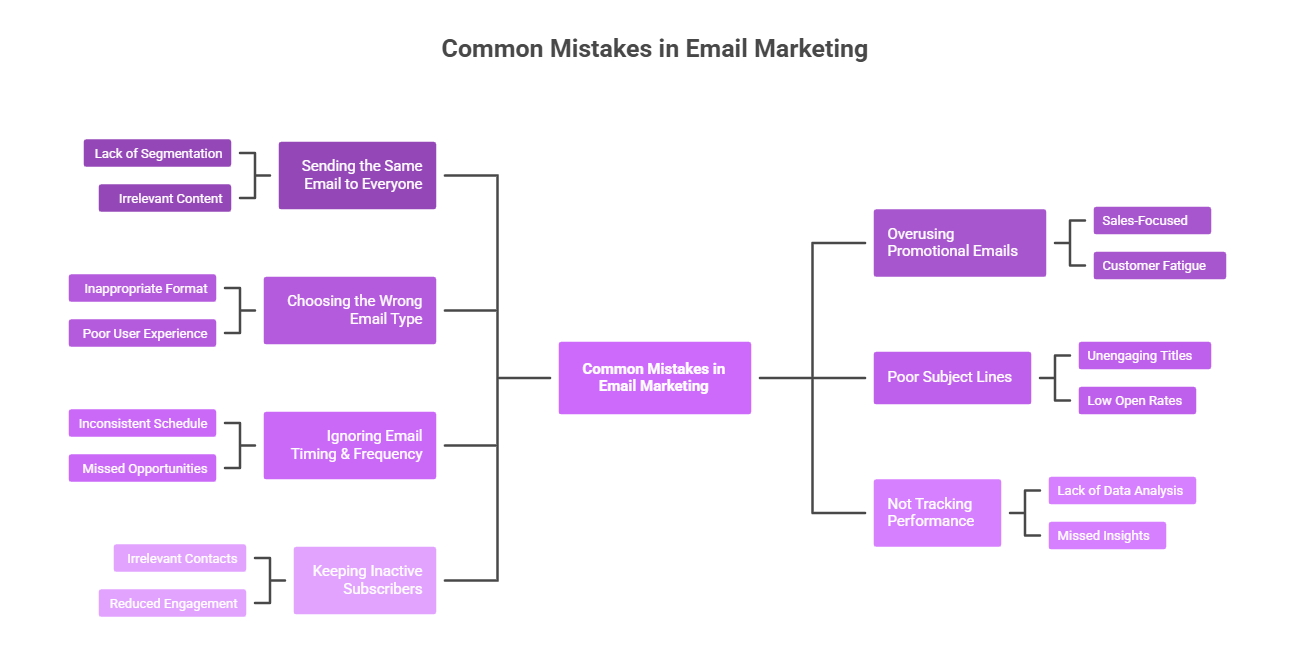
Most email marketing problems are self-created. Below are the most damaging mistakes businesses make.
- Sending the Same Email to Everyone
Ignoring segmentation leads to low open rates and unsubscribes. Users expect relevance, not mass messaging.
- Overusing Promotional Emails
If every email is a sales pitch, users stop opening them. Value must come before offers.
- Choosing the Wrong Email Type
For example, sending newsletters to cart abandoners or offers to cold leads kills conversions.
- Poor Subject Lines
Misleading or generic subject lines reduce open rates and damage trust.
- Ignoring Email Timing & Frequency
Too many emails = spam. Too few emails = forgotten brand.
- Not Tracking Performance
If you’re not tracking open rate, CTR, and conversions, you’re guessing, not marketing.
- Keeping Inactive Subscribers
Inactive lists hurt deliverability. Re-engage or remove them.
Conclusion
Understanding the types of email marketing helps businesses communicate better, convert faster, and retain customers longer. Each email type serves a specific purpose, and using them correctly makes email marketing profitable.
If you are looking for professional email marketing services, we can help you plan, design, and execute result-driven email marketing campaigns tailored to your brand. From strategy and automation to content and optimization, our team ensures your emails actually perform, not just land in inboxes.
Connect with us today to grow your business with smart and effective email marketing.