Skip to content
Difference Between Web App and Mobile App: A Complete Business Guide for 2026
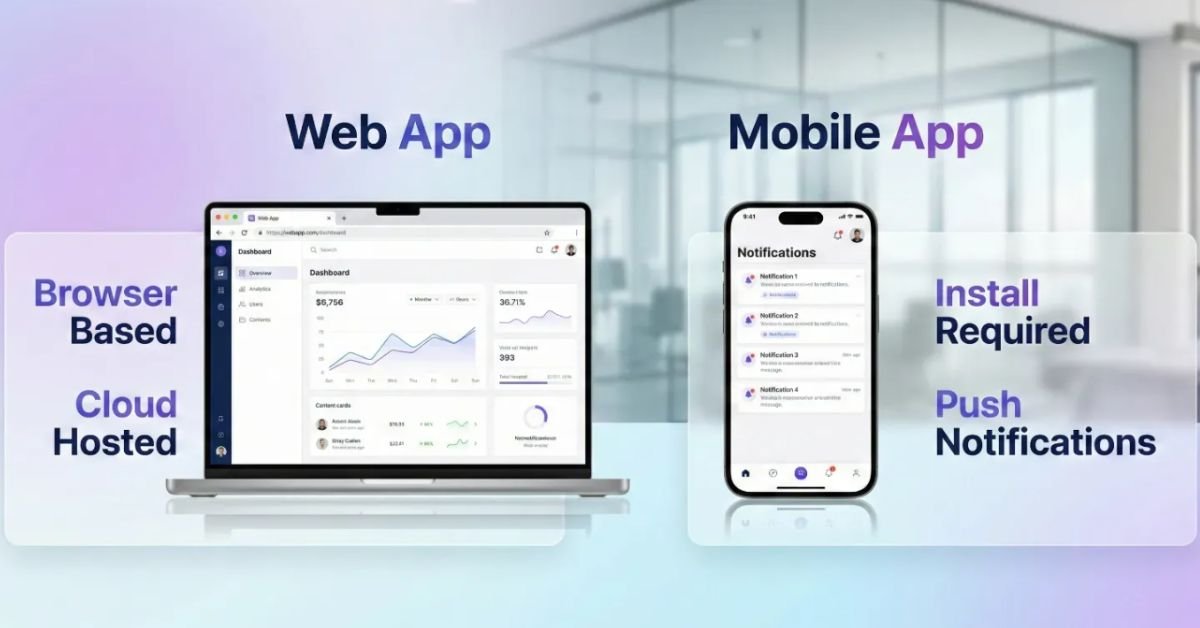
When companies intend to develop a digital product, an issue always arises at the initial stage. Which one is better: a web or a mobile application? Although both are similar, the distinction between a web application and a mobile application is far more in-depth than what is involved in accessing the application by the user.
This choice has an implication on the cost of development, performance, search engine visibility, user-experience, scalability, and future growth. We are going to elaborate on everything in this guide in simple language, real-world logic, clear points, and proper explanation in order to ensure that you are able to make a confident choice when it comes to the correct option for your business.
What Is a Web App?
A web app is an application that is implemented in a web browser and is accessed with the help of a URL. In contrast to static websites, web apps enable communication with data and allow users to log into their accounts, take actions, and get real-time notifications.
Typical examples of web apps are SaaS services, customer relationship management software, project management software, analytics software, and booking software.
How a Web App Works
A web app is hosted on a server. Once a user clicks on the app in a browser, the interface opens and contacts the server to retrieve or send data. All updates occur at the server and this implies that the users can always be up to date with the latest version without necessarily downloading anything.
The configuration allows web applications to be flexible, scalable and maintainable.
Benefits of Web Apps
1. Lower Development and Maintenance Cost
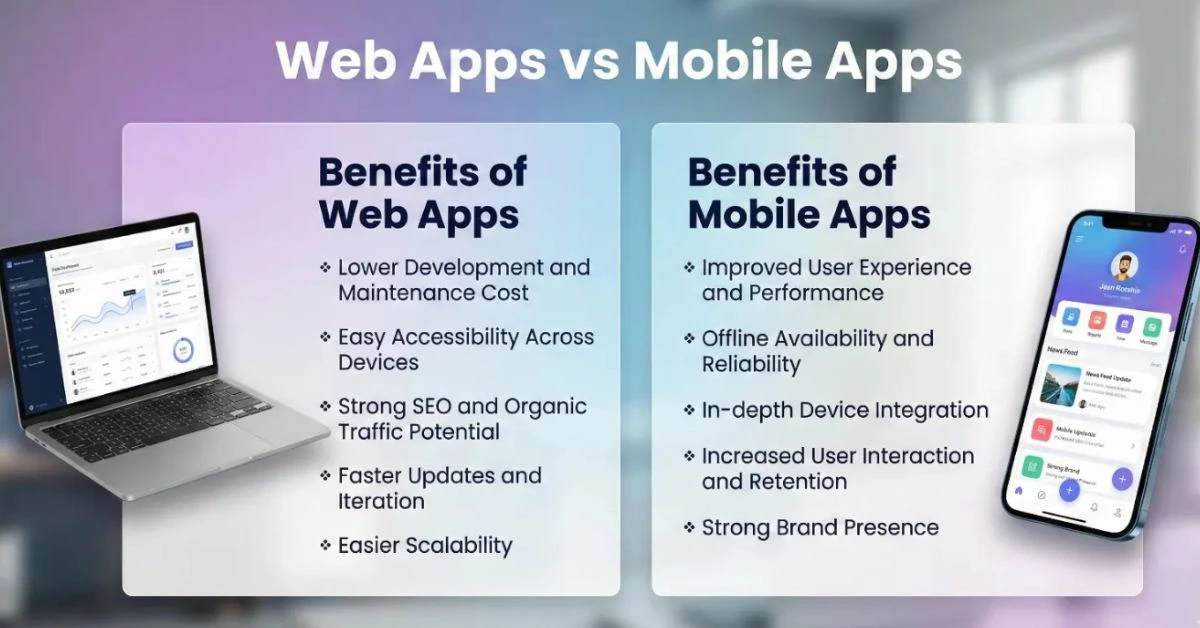
Web apps use a single codebase that works across devices, reducing development and long-term maintenance costs. Updates are instant and do not require user action.
2. Easy Accessibility Across Devices
Users can access web apps from desktops, laptops, tablets, and smartphones, increasing reach and usability.
3. Strong SEO and Organic Traffic Potential
Web apps can rank on search engines, driving consistent organic traffic and reducing dependency on paid ads.
4. Faster Updates and Iteration
Businesses can launch new features or fix bugs instantly, making web apps ideal for fast-growing startups.
5. Easier Scalability
Scaling a web app is straightforward by upgrading servers or optimizing performance without worrying about device compatibility.
What Is a Mobile App?
A mobile application is one that is built to work with smartphones and tablets. It is downloaded by users on the app store like Google Play or the Apple App Store, and installed on the device.
They are social media applications, ride-hailing applications, fitness applications, food delivery applications, and streaming applications.
How a Mobile App Works
The mobile applications are installed directly on the user’s device, and this means that the user interacts with the hardware of the phone. This allows such capabilities as push notifications, camera access, GPS location, offline usage, and biometric access.
The mobile apps are platform-specific, hence they tend to have better performance and a more pleasant user experience.
Benefits of Mobile Apps
1. Improved User Experience and Performance.
Mobile applications are designed to work with particular platforms, thus they become more coherent and responsive.
2. Offline Availability and Reliability.
Mobility applications have the capability of storing data locally and operating without internet connectivity.
3. In-depth integration with the features of devices.
Such functions as GPS, camera, notifications, and biometrics provide high-tech functionality.
4. Increased User Interaction and Retention.
Personalized experience and push notifications can be used to re-engage users and generate loyalty.
5. Strong Brand Presence
An installed app increases brand visibility and trust through constant presence on a user’s device.
Web App vs Mobile App
| Aspect | Mobile App | Web App |
|---|---|---|
| Access Method | Users must download and install the app from platforms like Google Play Store or Apple App Store, which adds an extra step before usage. | Users can access the web app instantly through a browser using a URL, making it more accessible for first-time users. |
| Platform Dependency | Mobile apps are built for specific platforms such as Android or iOS, often requiring separate development efforts. | Web apps are platform-independent and work across devices as long as a browser is available. |
| User Experience | Mobile apps provide a highly optimized and interactive experience tailored to touch gestures and native UI patterns. | Web apps offer a consistent experience but are limited by browser capabilities and screen responsiveness. |
| Functionality & Features | Mobile apps can support complex functionalities and advanced features by directly using device hardware. | Web apps can handle many features, but may struggle with hardware-intensive or advanced native functionalities. |
| Updates & Maintenance | Updates need to be downloaded by users from the app store, which can delay feature rollouts and bug fixes. | Updates are deployed on the server and reflected instantly for all users without any action required. |
| Performance | Mobile apps generally deliver faster performance and smoother navigation because they utilize device resources directly. | Web app performance depends heavily on browser efficiency and internet connection quality. |
| Offline Availability | Many mobile apps can function partially or fully offline, improving usability in low-connectivity environments. | Web apps typically require an active internet connection, with limited offline capabilities. |
| Development Cost | Development costs are higher due to platform-specific builds, testing, and long-term maintenance. | Web apps are more cost-effective since a single codebase serves multiple platforms. |
| Discoverability & SEO | Mobile apps have limited visibility on search engines and rely heavily on app store optimization. | Web apps can be optimized for SEO, making them discoverable through organic search traffic. |
| Deployment Speed | App store approvals and reviews can delay deployment and updates. | Web apps can be launched and updated quickly without external approvals. |
Performance and User Experience
Mobile applications can typically provide better performance and general interactions as they are designed to work on mobile computers. Gestures, transitions, and animation are more natural, and this enhances the satisfaction of the user.
Web applications have become better, particularly the current frameworks and Progressive Web Apps. Nevertheless, they remain reliant on the performance of the browser and the speed of the internet which may restrict complicated or real-time communications.
Mobile apps tend to be more enabling in case your product is speed-intensive and requires interactions on a daily basis.
Common Mistakes Businesses Make
1. Building a Mobile App Without Validating Demand
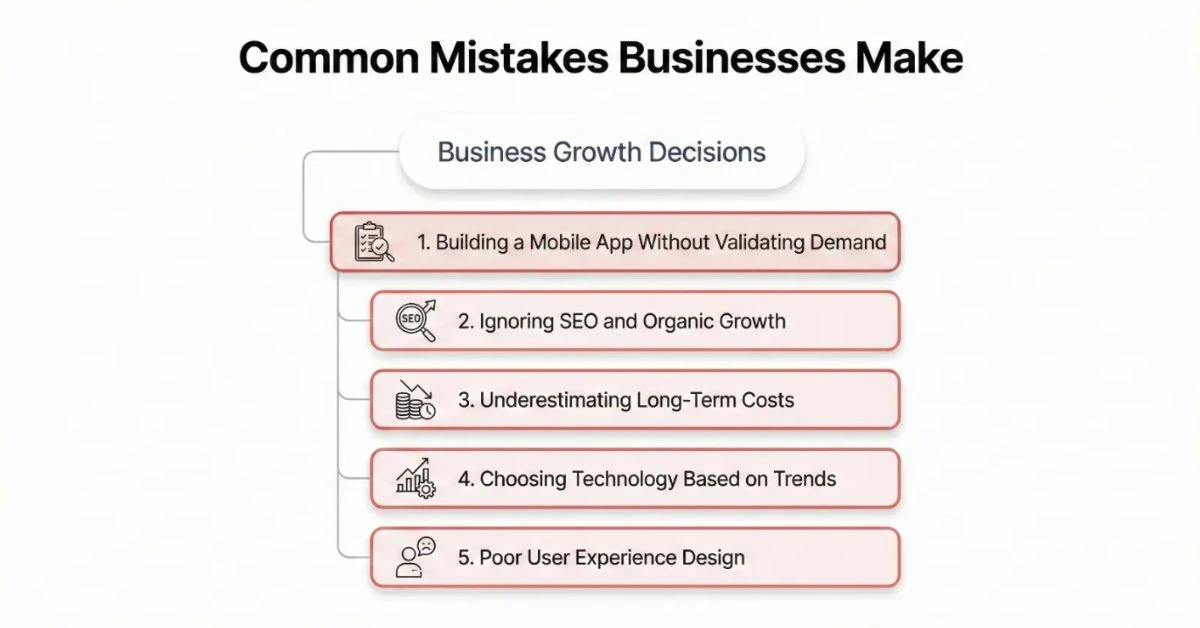
Many businesses invest in mobile apps before confirming user need, leading to low downloads and wasted budget.
2. Ignoring SEO and Organic Growth
Mobile-only strategies often overlook SEO, increasing reliance on paid acquisition.
3. Underestimating Long-Term Costs
Maintenance, updates, and platform compatibility often cost more than expected.
4. Choosing Technology Based on Trends
Technology decisions should align with business goals, not competitors or trends.
5. Poor User Experience Design
Even powerful apps fail if usability and performance are ignored.
When Should You Choose a Web App?
Select a web app in case you desire timely launching, reduced cost, scalability, and organic growth in traffic. Web applications are applicable in SaaS services, player dashboards, booking platforms, and content-based companies.
When Should You Choose a Mobile App?
Select an app on the phone, when it is important to engage, perform, use it offline, and frequently. Mobile applications are appropriate to the products that need to be touched every day or real-time functions.
Using Both Web App and Mobile App Together
A large number of businesses that perform well use both. The web application takes control of the SEO, onboarding and desktop users, whereas the mobile application concentrates on the engagement and retention. Such a moderate solution is the best to get the maximum reach and experience.
Final Conclusion
The distinction between a web and a mobile app is not about the superiority of either. It is about making decisions that are in line with your audience, budget, and growth strategy.
Require Professional Assistance in selecting or creating the appropriate App?
At India Digital Agency, we assist companies to design, strategize, and develop scaled-up web apps and mobile apps that are supported by robust search engine optimization and digital development policies. Our team stresses performance, visibility, and long-term success, whether it involves introducing a new product or improving an already existing product.
Visit indiadigitalagency to explore our services or connect with us for a strategy-first consultation.