360-Degree Marketing Strategies to Grow Your Business in 2026

Most businesses today are marketing across different platforms, but their efforts are scattered and disconnected. Customers see one message on social media, another tone on the website, and a completely different approach in ads. This inconsistency affects trust, reduces conversions, and makes the entire brand look confused.
A 360-degree marketing strategy solves this problem by creating a unified, seamless experience across every touchpoint so your customer never gets lost, confused, or disconnected.
A strong 360-degree system allows your audience to recognize your brand instantly—whether they find you on Google, Instagram, YouTube, email, or even offline.
This blog will walk you through a complete, practical understanding of how 360-degree marketing works and how it can help your business grow predictably.
What Is 360-Degree Marketing?
A 360-degree marketing strategy ensures your customers experience a consistent brand message and identity across every platform, online and offline. It is not about simply showing up everywhere, it is about connecting every channel so the customer journey feels smooth, intentional, and aligned.
The core Philosophy Behind 360-degree marketing
1. Unified Messaging
Your brand should communicate the same tone, values, and promise everywhere.
2. Connected Customer Journey
Every touchpoint should push the customer one step forward in the buying process.
3. Aligned Online + Offline Presence
Your digital presence and offline interactions should match.
Why Your Business Needs 360-Degree Marketing Today
Customers do not buy instantly anymore. They research, compare, read reviews, check social media, and return multiple times before deciding. If your brand feels inconsistent during this journey, they prefer your competitor.
Reasons Why 360-Degree Marketing Is Essential
- Customer Behavior Is Multi-Touch
- Brand Trust Depends on Consistency
- Competition Is Higher Than Ever
- Data-Driven Personalization Converts Better
| Customer Behavior Is Multi-Touch | Brand Trust Depends on Consistency | Competition Is Higher Than Ever |
|---|---|---|
| People switch between 5–10 platforms before buying anything. | Inconsistent brands look unreliable. | Your competitors are already using multi-channel strategies. |
| A user may find you on Google, follow you on Instagram, watch a YouTube review, and then click an ad later. If every touchpoint feels aligned, they build confidence faster. | If a customer sees different information on different platforms, they assume the brand is confused or low-quality. Consistency builds trust, and trust drives sales. | If you rely on only one platform, just Instagram, just SEO, or just ads, you will lose customers to competitors who appear everywhere with a unified story. |
How 360 Degree Marketing Works
A 360-degree strategy works by aligning every step of the customer’s journey. Each platform plays a different role, but all lead toward a single goal – conversion and brand loyalty.
How the System Flows
Awareness → Interest → Trust → Action → Loyalty
Each platform supports the previous one
1. Awareness
The customer discovers your brand through ads, search, reels, or recommendations.
This is the first impression. If your message is unclear or weak, the journey ends here. Strong 360-degree branding makes the customer want to explore further.
2. Interest
They visit your website or social media to learn more.
Your content, visuals, and brand story must immediately make sense. This is where your website, SEO content, and high-quality social media presence matter.
3. Trust
The customer checks reviews, testimonials, and social proof.
Without trust elements, customers walk away—even if your product is excellent. Trust touchpoints like reviews, case studies, and user-generated content strengthen your credibility.
4. Action
A retargeting ad, email reminder, or offer pushes them to buy.
People rarely buy the first time. Retargeting and nurturing fill the gap and bring the customer back to take action.
5. Loyalty
Post-purchase communication keeps them connected to the brand.
Email automation, helpful content, and consistent branding turn customers into repeat buyers—not just one-time shoppers.
Core Components of a 360-Degree Marketing Strategy
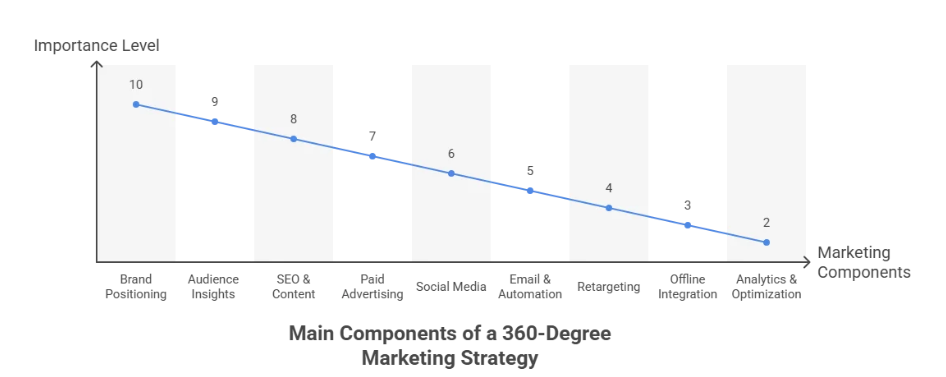
1. Brand Positioning
Your brand identity, tone, and value proposition must be clearly defined.
If you don’t know what your brand stands for, your audience won’t know either. Positioning becomes the backbone of your 360-degree system.
2. Audience Insights
You must understand what your audience needs, fears, and expects.
Without deep audience insights, your messaging feels generic. A 360-degree strategy succeeds only when communication speaks to real emotions and real problems.
3. SEO & Content Strategy
Organic visibility brings long-term authority.
Blogs, guides, and educational content build trust and attract high-intent customers from Google. SEO is the silent engine behind most successful 360-degree brands.
4. Paid Advertising
Fast visibility and targeted reach.
Ads are powerful, but only when supported with strong content, trust signals, and brand consistency. Ads cannot work alone.
5. Social Media Presence
Your brand must look alive and active.
Customers often check social media before buying. Strong social media gives them confidence that your business is genuine and dependable.
6. Email & Automation
Not everyone buys instantly.
Email nurturing helps you stay connected, answer doubts, and move the customer from the interest to the decision stage.
7. Retargeting
Reminds customers who forgot about you.
Most users don’t convert the first time. Retargeting ads bring them back at the right time with the right message.
8. Offline Integration
Make sure your offline presence aligns with your online identity.
Events, brochures, packaging, and physical interactions should match your online branding for a smooth 360-degree experience.
9. Analytics & Optimization
Data is the backbone of improvement.
You need clear dashboards to track behavior, performance, and ROI. Without data, your 360-degree strategy becomes guesswork.
Step-by-Step Blueprint to Build a 360-Degree Marketing Strategy
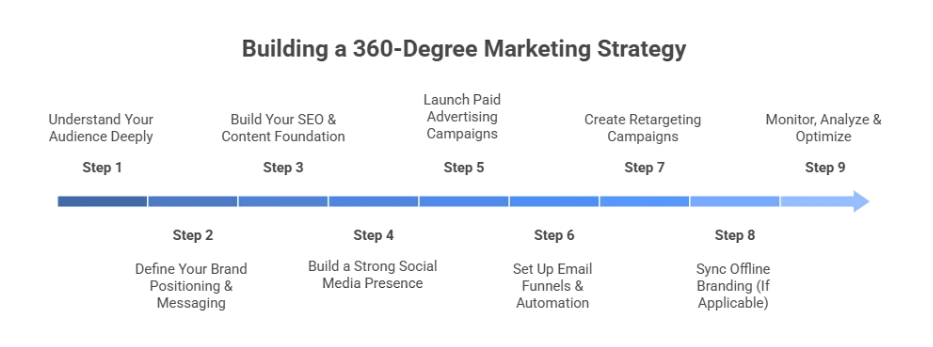
Before jumping into tools or tactics, you need a structured system. A 360° strategy only works when every part of the marketing ecosystem connects with the next.
Below is a clear blueprint that any business can follow:
Step 1: Understand Your Audience Deeply
Before creating ads, posts, or content, you need to know who you’re talking to. Most businesses guess their audience, and then they wonder why results are inconsistent.
Key Points:
- Identify needs, fears, motivations
- Understand buying behaviour
- Map decision-making patterns
Your audience is not just “people interested in buying.” They are individuals with emotions, doubts, and expectations. When you understand what they want, what stops them from buying, and what makes them trust a brand—you automatically create marketing that feels personal and relatable. This understanding becomes the backbone of your entire 360° ecosystem.
Step 2: Define Your Brand Positioning & Messaging
Customers should know who you are, what you stand for, and why you’re different, within 5 seconds of seeing your brand anywhere.
Key Points:
- Unique value proposition
- Brand voice & tone
- Core message pillars
Brand positioning is not about fancy slogans—it’s about clarity. If your brand speaks differently on every platform, customers lose trust. Your positioning ensures that whether someone sees your Instagram post or views your Google Ad, they get the same confident message. This consistency builds recognition, reliability, and authority.
Step 3: Build Your SEO & Content Foundation
Without strong SEO and helpful content, your audience will not find you organically. Paid ads can bring traffic, but content builds long-term credibility.
Key Points:
- Keyword-rich blogs
- Service pages with clear intent
- Topic clusters & FAQs
Search engines follow user behaviour. When you publish content that directly answers customer questions and solves real problems, Google automatically pushes your brand forward. A 360° strategy without SEO is incomplete because organic visibility becomes the “silent salesperson” working for you 24/7.
Add a link to your “SEO Services” page here.
Step 4: Build a Strong Social Media Presence
Your social platforms act as your brand’s personality. People check Instagram, LinkedIn, or YouTube to see if your business is active and trustworthy.
Key Points:
- Consistent posting schedule
- Value-driven content mix
- Engagement-based growth approach
People don’t follow brands that only sell, they follow brands that help, educate, entertain, and inspire. When your social content is aligned with your SEO messaging, the customer sees a unified story everywhere. This reduces friction, increases trust, and pushes them closer to a buying decision.
Step 5: Launch Paid Advertising Campaigns
Paid ads help you capture demand quickly. But ads only work when the rest of your ecosystem supports them.
Key Points:
- Google Ads for search intent
- Meta Ads for awareness
- LinkedIn Ads for B2B targeting
Paid ads amplify your reach, but they can’t carry your brand alone. They work best when people have already seen your content, interacted with your posts, or visited your website. A 360° strategy uses ads strategically, not randomly, and ensures buyers get a complete experience from first impression to final purchase.
Step 6: Set Up Email Funnels & Automation
Not every visitor will buy instantly. Email nurturing is where interested leads turn into paying customers.
Key Points:
- Welcome sequences
- Value-based nurture emails
- Offer-driven conversion flows
People need multiple touchpoints before they trust a brand. Email marketing keeps your brand alive in their mind even after they leave your website. When done right, email becomes the strongest retention channel, bringing back customers even months later.
Step 7: Create Retargeting Campaigns
Most customers leave your site without taking action. Retargeting brings them back when they are mentally ready to buy.
Key Points:
- Website retargeting
- Social retargeting
- Abandoned funnel recovery
Retargeting works because the customer already knows you—they just need a reminder or a push. These ads convert far better than cold ads because the doubt is already lower. In a 360° system, retargeting fills the gaps that normal marketing cannot.
Step 8: Sync Offline Branding (If Applicable)
Offline and online branding should never feel disconnected.
Key Points:
- Events
- QR codes
- Print material
If your business also operates offline, customers should see the same brand identity everywhere—same colours, same tone, same promise. When online and offline merge, the brand looks more mature and stable, which boosts credibility.
Step 9: Monitor, Analyse & Optimise
A 360° marketing strategy is not “set and forget.” It evolves every month based on real data.
Key Points:
- Traffic analysis
- Engagement insights
- Conversion data
When you actively study what’s working and what’s not, your strategy becomes sharper and more powerful. You stop wasting money and time—and you invest only in what moves the needle. This optimization loop is what separates high-performing brands from average ones.
Essential Tools & Platforms for a Smooth 360° Marketing Strategy
You need smart tools that automate the work, track results, and help you maintain consistency across all platforms.
Below is a clean, practical list of tools every business should use, even if they’re small or just starting.
| Website & Landing Page Tools | SEO & Keyword Research Tools | Social Media Management Tools | Content Creation & Design Tools | Email Marketing & Automation Tools |
|---|---|---|---|---|
| WordPress | Google Search Console | Buffer | Canva | Mailchimp |
| Webflow | Google Analytics | Hootsuite | Adobe Express | ActiveCampaign |
| Shopify (for eCommerce) | Ahrefs / SEMrush | Later | Figma | HubSpot |
| Elementor / Divi / Avada (page builders) | Ubersuggest | Metricool | CapCut (for reels) | Sendinblue |
| Analytics & Tracking Tools | Paid Advertising Tools | CRM & Lead Management Tools | Retargeting & Remarketing Tools | Team Collaboration & Productivity Tools |
|---|---|---|---|---|
| Google Analytics 4 | Meta Ads Manager | HubSpot CRM | Google Remarketing | Notion |
| Hotjar | Google Ads | Zoho CRM | Meta Retargeting | Slack |
| Meta Pixel | LinkedIn Ads |
Pipedrive |
AdRoll | Trello |
| Google Tag Manager | YouTube Ads | Salesforce | Asana |
Pros & Cons of 360-Degree Marketing
| Pros | Cons |
|---|---|
| Creates a consistent and professional brand image across all platforms. | Requires more planning, resources, and coordination compared to one-channel campaigns. |
| Boosts conversions by meeting the customer at every stage of their buying journey. | Can become expensive if managed inefficiently or without strategy. |
| Uses data from all channels, improving campaign accuracy. | Tracking and attribution can get complex without the right tools. |
| Offers long-term brand growth and customer trust. | Not suitable for businesses with no team or no ability to maintain multiple channels. |
| Increases customer loyalty through repeated brand interactions. | Execution mistakes in one channel can affect the whole ecosystem. |
Conclusion
If you want your business to attract better leads, build trust faster, and convert more customers without wasting money on scattered efforts, then a 360° strategy is the smartest direction to move.
If you need help creating or executing a complete 360° marketing strategy for your business, my team at Indian Digital Agency (IDA) can support you with website development, SEO, content, ads, and full-funnel marketing. Just reach out us to build your growth engine.